.svg)

Well-adopted, stable, and trusted design systems usually have one thing in common: a clear mandate from leadership.
The trick is getting that mandate, which is like herding cats. In Zeroheight’s Design System Report 2025, more than 50% of respondents said they find securing buy-in for design systems a challenge.
There are ways of getting these bosses to budge. So, let’s break down how to make the case for a design system in terms of team needs, business needs, and design system ROI (return on investment).
It’s obvious we need a frickin' design system—says the designers and developers who use them daily.
Unfortunately, senior management don’t, which is why the value of design systems needs to be explained.
According to the Design System Report 2025, the biggest challenge faced by design system users is a lack of resources or staffing. In other words, there’s not enough investment in the design system, which is because the managers don’t think there should be.

Part of the problem is that for years the design community has referred to design systems as products. But products are supposed to make money. Design systems don’t generate revenue directly; they make money by improving your products, reducing inefficiencies in your design and development processes, and facilitating collaboration between stakeholders. These things are harder to quantify, which is why some leaders struggle to perceive their value and deprioritize them.
It’s not that different to failing to see the value of marketing. I’ve worked with CEOs who try to distill marketing ROI into a simple figure, even though a lot of the return is intangible. Things like brand awareness and consumer trust don’t show up on a financial statement.
“Once you have buy-in from the leaders, they will be the ones pushing for the system to be used and maintained, and they’ll facilitate it. It’s why leadership buy-in has to come first.”
Leon Ephraïm, Co-Founder & Creative Director, Yummygum
It’s important to take a strategic approach to securing buy-in for your design system. The approach taken by digital product agency Yummygum is to treat design systems as a strategic layer rather than an optional asset. Because they work with scaling tech companies trying to increase speed without sacrificing quality, they anchor the design system to the broader company strategy so leadership sees its impact on delivery, consistency, and long-term product health.
It’s the same reason Yummygum tackle issues like slow velocity, technical debt, misaligned visuals, and unclear brand identity. A well-structured design system cuts through those problems and gives companies a foundation they can scale with confidence. For Yummygum, securing buy-in is not just a practical step but the starting point for building a system that supports sustainable growth.
It’s easy for management to justify not investing in design systems when they see them as products that don’t make money. That’s why it would be better to refer to design systems as infrastructure.
Infrastructure is the services and systems we rely on to do our work. It includes the software platforms we use day to day, like Figma, Storybook, Jira, and Confluence. But it also includes basic utilities like internet and electricity that our businesses can’t function without.
Framing design systems as infrastructure will help managers understand how essential they are. You can’t deprioritize the provision of electricity. If a vital system goes down that people use to do their work, well, the work stops. And of course, if we want to keep our utilities running, we need to maintain them.
So, refer to the design system as infrastructure when you meet with leadership, and explain why. If they question you, go cut the power to the office to demonstrate.
Just like with marketing, you can’t boil down the ROI of a design system into one, simple number.
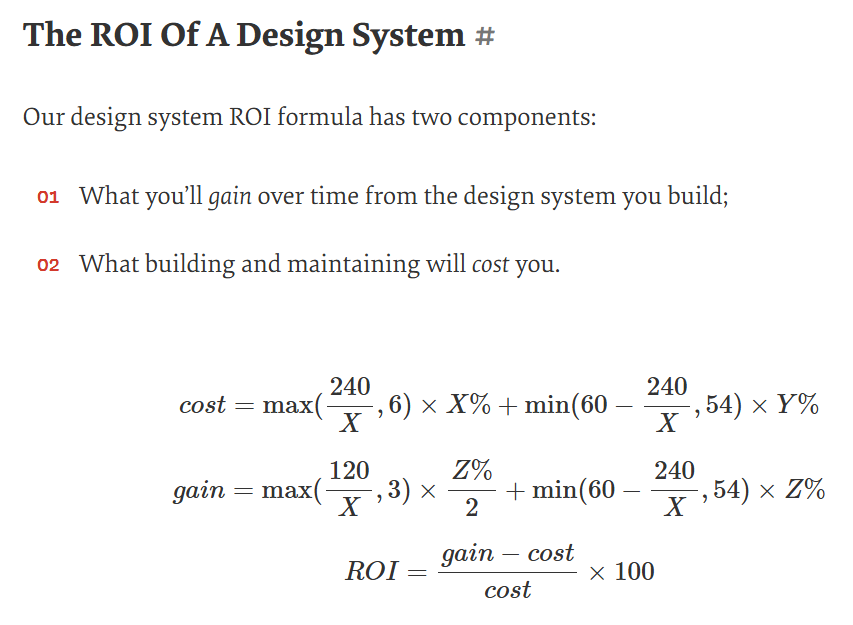
That said, there are ways of approximating the return for a manager who needs some figures before she commits. Smashing Magazine came up with a clever general formula for calculating design system ROI.
It’s too complicated to repeat it all here, but here’s the long and short.
Smashing Magazine estimates design teams are 38% more efficient and development teams are 31% more efficient thanks to design systems. These figures are gleaned from a range of studies into how design systems reduce time spent on design and development work.
Minus the cost of setting up and maintaining the design system, Smashing Magazine estimates design system ROI to be 135%, with a $871,400 net gain over 5 years.
Design system ROI gives leadership a tangible figure to work with. But the efficiency estimates used to calculate the ROI rely on averages from a whole bunch of surveys and experiments across various companies. So it might be even more persuasive to dig into a few of them and see exactly what those gains look like.

Figma conducted an experiment which revealed the efficiency gains from a design system to be equivalent to adding 3.5 designers to their team of 7 each week.
Bryn Ray, Head of Design Strategy at Bloomberg, did projections for a client and found that a design system could reduce delivery time from 277 hours to 190 hours, increasing the number of deliveries from 11 to 16. He also found that a design system could improve product quality by 18%.
Forbes' report on marketing and branding stated that consistent branding can increase revenue by 23%. Also, color consistency alone can improve brand recognition by up to 80%.
Travel and hospitality company Alibaba estimated a 50% faster design-to-dev handoff thanks to their design system. The design systems team at Twitch stated why this could be. They said that their system gives designers and developers 80% of what they need, allowing them to focus on the other 20%.
It’s important to get across to leadership that design systems have qualitative and strategic benefits that can’t all be described in numbers.
Team happiness is a big benefit of design systems. A design system allows designers and developers to work together with less friction, to speak the same language and avoid misalignment on how components should look and behave.
Design handoff is also quicker and smoother because designers don’t have to provide extensive technical information about every design; it’s right there in the design system.
Finally, design systems reduce error and redundancy such as using the wrong button or font by mistake, or recreating components from scratch that already exist. This gives teams more confidence in their work.
When companies scale up, they need structure. Without a design system, new hires won’t have any idea what they’re doing. They’ll be reinventing components, bloating the codebase, and causing visual and functional inconsistencies in your products and user experiences (UX).
They’ll also take ages onboarding while they try to understand how things work and what to contribute—because there’s no centralized source of truth to tell them.
Design systems offer companies an established structure that new workers can build on. It also means that they don’t all need to be the best, because junior and less experienced employees will have a bank of ready-made components and patterns at their fingertips. This helps with hiring, onboarding, and speed to market.
The first step is persuading leadership that a design system is a worthwhile investment. Once you have that, you need to maintain the buy-in so that management keeps dedicating resource to the system. A design system isn’t static; it grows and changes all the time, and there needs to be a dedicated design system team of at least one designer and one developer to keep it updated.
There are various ways of maintaining leadership buy-in. Yummygum uses a mix of measurable indicators and ongoing visibility to keep design systems on leadership’s radar. They track component adoption rates, aiming for at least 70–80% reuse of system components across active products, and flag any patterns being rebuilt outside the system. They monitor accessibility benchmarks such as average contrast ratios above 4.5:1 and a target of 90% WCAG AA compliance across live components.
They also aim to reduce redundant component creation by 40%, measured through periodic team surveys that track how often designers or developers recreate existing patterns. Documentation completeness and accuracy are measured too: every component must include usage guidelines, interactive examples, and code references before being marked as production-ready.
Yummygum establishes success criteria early on. This could include reducing design-to-dev handoff time by 25%, maintaining cross-platform UI consistency above 85%, and tracking time-to-implement for new features as a proxy for efficiency.
These numbers give leadership a concrete sense of progress rather than relying on subjective perception. When reports show that component reuse is up, accessibility scores are improving, and delivery cycles are shortening, the design system stops being a cost center. It becomes proof of operational maturity worth sustaining.
Although understanding the true value of a design system can be complex, it’s management’s job to navigate those complexities to make sure their company is operating at peak efficiency.
There has to be willingness on both sides to put in the time to do that, because getting to grips with design system ROI does take more time, just like it does with marketing ROI. There are ways of approximating the return with formulas and looking at gains other companies have made, but you’ll never arrive at one, simple figure.
And you should go beyond the figures anyway—again, just like you have to do with marketing. That’s because design systems have benefits like scalability, brand consistency, and team happiness. You just can’t put a number on those things.
We, and Yummygum, are in agreement that one day design systems will be so pervasive that they’ll be considered a baseline requirement and you won’t need to persuade leadership of their value. Like how many CEOs now view marketing. It’s not a nice-to-have. It’s a growth enabler.
But until that time, you can use the techniques in this article to win over your uninitiated or skeptical leaders. Or get Yummygum to help.
A former lawyer, Berry loves theme parks, has published a sci-fi conspiracy thriller trilogy called Million Eyes to rave reviews, and is a specialist in writing content for tech companies.