Docs
Menu
Close
The Figma for Confluence Pro app allows users to attach Figma designs to Confluence pages. Whenever a user views an page that has a Figma design attached, all the attached designs (and their corresponding metadata) is retrieved from the Figma API.
Each design is processed by the Confluence instance and stored in memory during transfer from the Figma API. Given that the size of a Figma design can range from <1MB to >100MB, large Data Center instances with many active users can experience issues with resources like CPU and memory consumption. This can result in Java heap space Out of Memory errors in the Confluence application log.
In addition, due to the potential size of the Figma designs network requests to the Figma API are often long-running tasks which may cause the Confluence Data Center system to become unresponsive as the available number of worker threads of the application container are being consumed by these requests.
If you are experiencing issues with resource consumption, the first step is to enable caching. This will limit the amount of times the Confluence instance will have to connect with the Figma API to retrieve the same content. In large Confluence Data Center instances, this can reduce the memory consumption by the Figma for Confluence app as the design will only be stored in memory once.
If you continue to experience issues with resource consumption after you have enabled caching, you will need to allocate more resources to your Data Center nodes in order to resolve the issue.
There are multiple reasons you may experience performance issues when trying to view Figma designs.
One of those reasons can be related to Figma API rate limiting. Whenever a user views an Confluence page that has a Figma design attached all the attached designs (and their corresponding metadata) is retrieved from the Figma API. As the Figma API rate limits are very strict, it is very easy to exceed the number of API requests for larger Data Center instances with many active users.
In order to resolve this, it is recommended to enable caching. When caching is enabled, the Figma for Confluence Pro app will store the Figma API response in memory. As this does not require a request to the Figma API, rate limits do not apply.
Another reason for loading issues can be that the Figma files are very large. A Figma design size can range from <1MB to >100MB. Retrieving a Figma design directly from the Figma API can become a long-running task, with requests taking 30-60 seconds to complete.
This issue is also resolved by enabling caching[link required]. The designs will now be readily available in the Confluence Data Center instance and do not require a request to the Figma API, improving load time performance from seconds to milliseconds (depending on the size of the design).
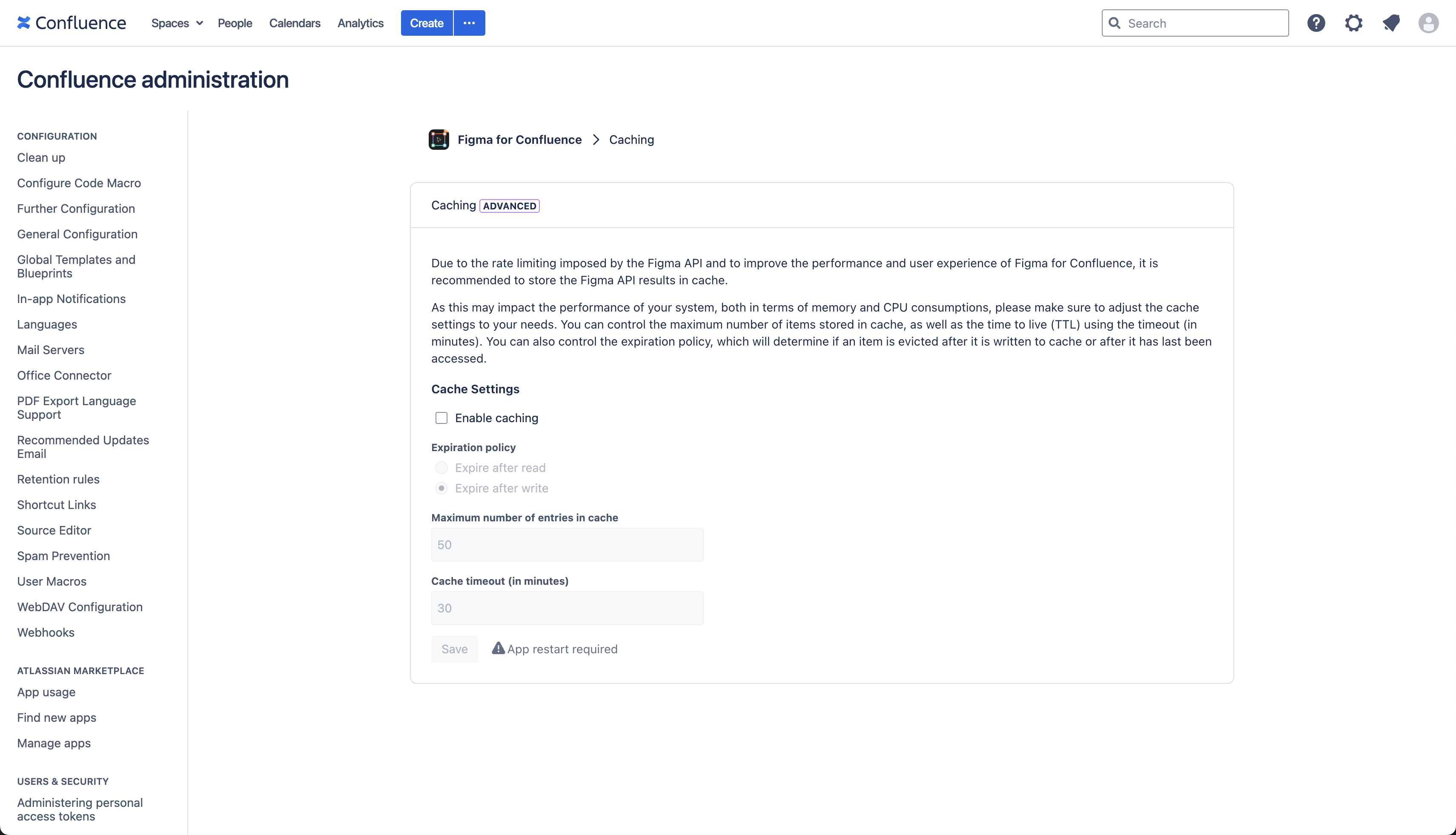
You can configure the caching feature in by taking the following steps: